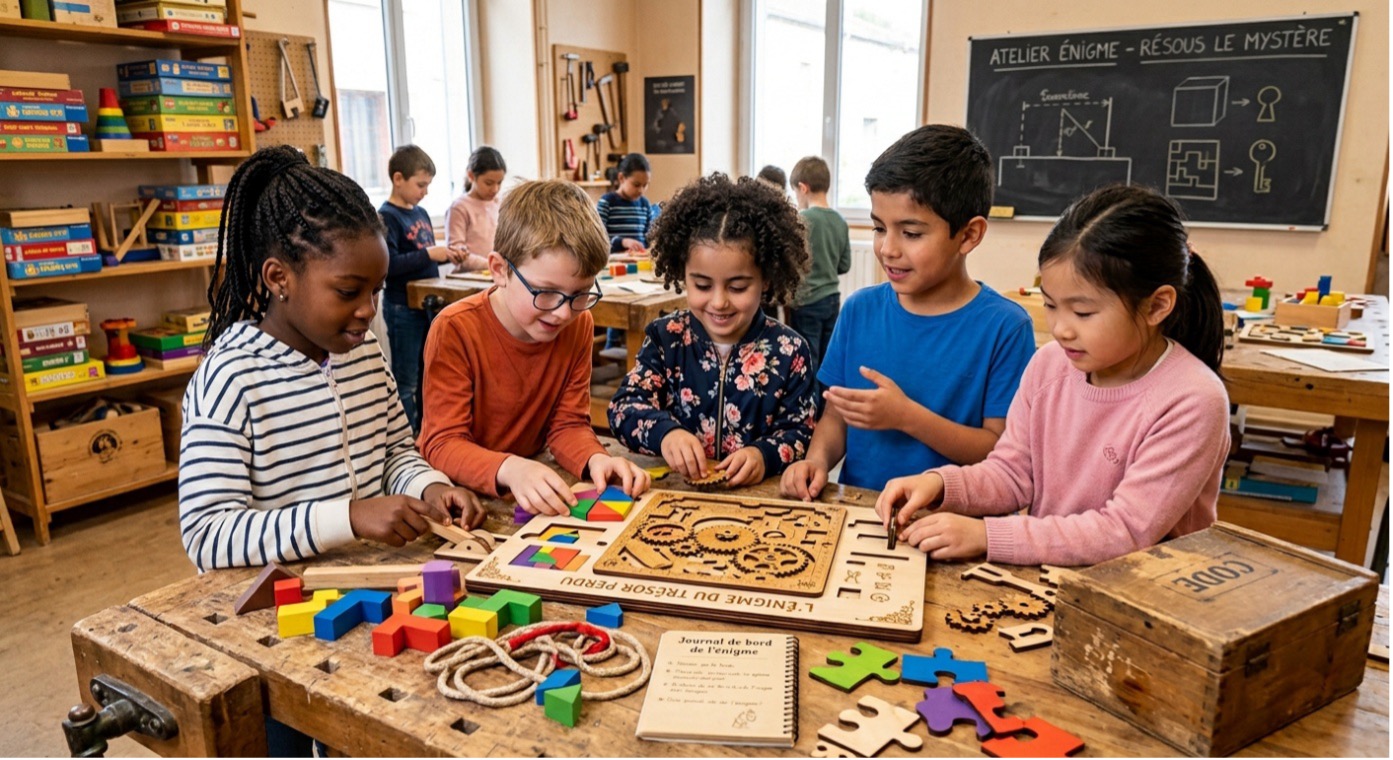
According to many PISA results from the OECD, math anxiety is a reality in many European classrooms. Faced with concepts that can seem abstract or off-putting, how can we capture pupils’ attention and reignite their curiosity? Specifically designed for primary school pupils aged 8 to 12, this is the central challenge addressed by the Enigmathico project.
By integrating enigmas, escape games, and logic challenges into the learning process, we are doing more than just “playing”: we are offering pupils a new mindset for approaching problem-solving. Here is why this approach can be a game-changer in the classroom.
Taking the sting out of mistakes through play
In a traditional school setting, making a mistake in mathematics is still too often perceived as a stressful verdict or even as confirmation of a lack of ability (“I’m not a math person”). This fear of failure leads to mental blocks: to avoid getting things wrong, many pupils prefer not to try at all.
The enigmas and “escape game” formats help shift the perception of the fear of failure:
- Immediate, non-punitive feedback: in a game, if a padlock code doesn’t work, there is no red pen or bad grade. Failure is not an end in itself; it is simply a signal that the chosen strategy is incorrect. The pupil receives this feedback without value judgment and immediately gets back to work.
- Valuing the “trial-and-error” method: solving a complex problem requires experimentation. Games legitimise this process. Formulating a hypothesis, testing it, seeing it fail, and then adjusting one’s actions becomes the norm. This lies at the very heart of the scientific method.
- Shifting from performance to mastery: the focus changes. The pupil no longer seeks a good grade to please the teacher, but rather aims to overcome an obstacle to help their team progress. This intrinsic motivation transforms the error into a simple technical challenge to be overcome.
By transforming the perception of errors, gamification encourages pupils to speak up and take initiative in the classroom. Pupils finally feel confident enough to propose ideas, engage in debate, and actively do mathematics.
Collaboration at the heart of problem-solving
Mathematics is often viewed as a solitary pursuit. Yet, research shows that verbalising ideas and debating with peers strengthen a deep understanding of concepts.
The scenarios developed for the Enigmathico project are designed to be collaborative. To solve a complex enigma, pupils must:
- Distribute tasks (searching for clues, performing calculations, cross-referencing data).
- Present arguments to convince their peers of the validity of their method.
- Pool their skills, allowing pupils with different learning profiles to be valued within the group.
Abstract concepts rooted in reality
One of the most common questions pupils ask is: “What is the use of this in real life?”
The narrative-driven approach of our resources helps contextualise theorems and formulas. Whether calculating proportions to prepare a fictional antidote or using geometry to decipher a treasure map, mathematics returns to its fundamental nature: a tool for understanding and interacting with the world.
What the Enigmathico project offers
The goal goes beyond theory. The Enigmathico consortium is actively working to provide teachers with ready-to-use tools that have been classroom-tested and are adaptable across 8/12 years old grade levels.
Feel free to visit the Unlock page of our website to download our latest boxes for free in 5 languages (English, French, Polish, Romanian, and Greek). Have you tried one of our enigmas in class? Share your feedback and your pupils’ reactions on the “Contact” page of the site!