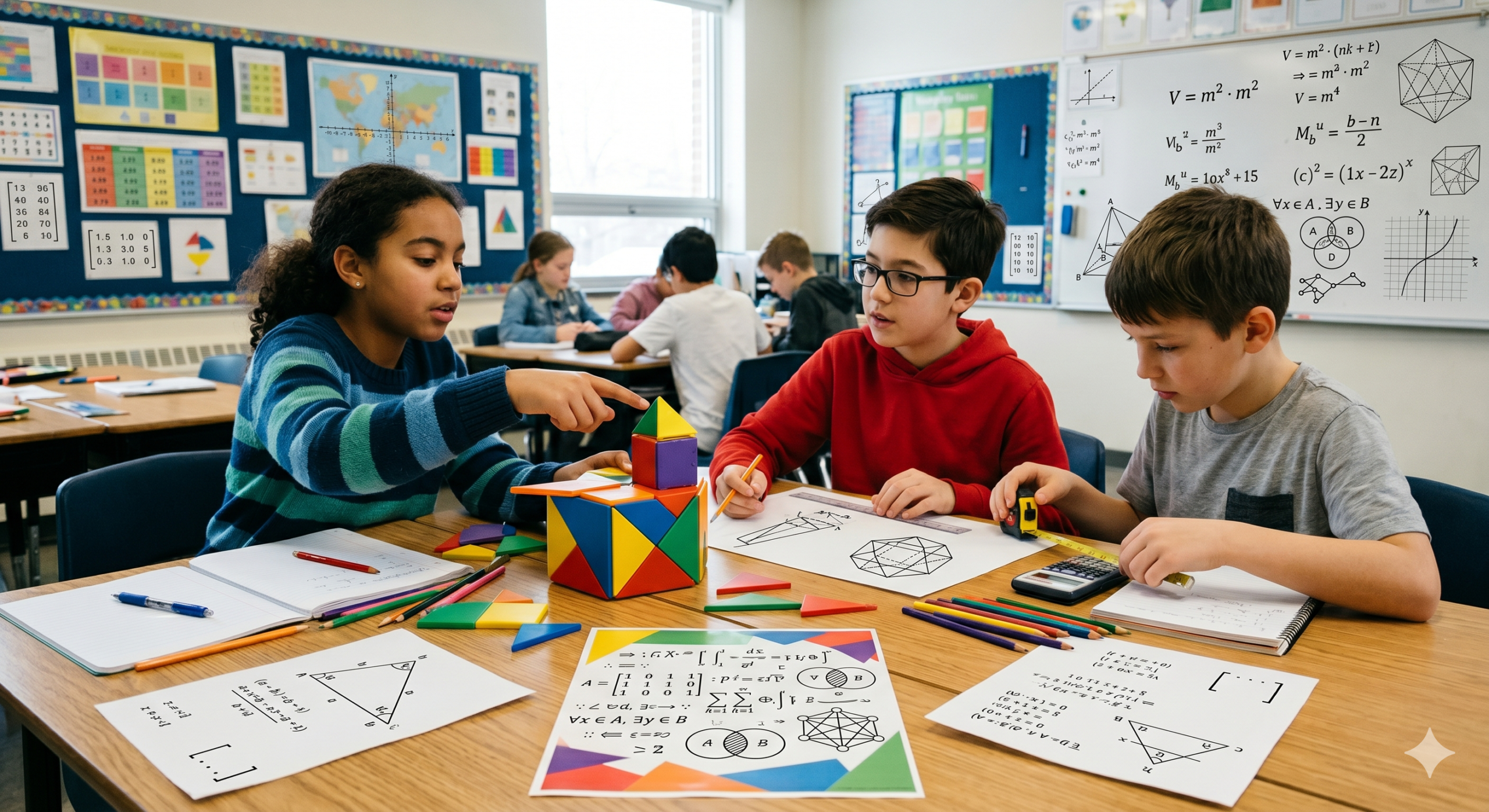
Mathematics is not just about numbers and formulas. It is a way to develop thinking skills that help children solve problems in everyday life. When pupils learn math, they practice organizing their thoughts, making decisions, and finding solutions to challenges. For young learners, math can be exciting and engaging when taught through hands-on activities, games, and storytelling. This article explores how math helps children think critically, how it applies to real-world situations, and how teachers can make math fun and meaningful in the classroom.
But what is critical thinking really?
Critical thinking is the ability to analyze information, evaluate options, question assumptions, and make reasoned, justified decisions. It involves skills like: analyzing and interpreting information, evaluating evidence or possible solutions, justifying choices with clear reasoning, reflecting on whether a conclusion makes sense.
In the context of mathematics education, critical thinking is closely connected to—but distinct from—problem solving. While problem solving focuses on arriving at a solution, critical thinking shapes how and why that solution is reached.
Research supports this distinction:
- Alan H. Schoenfeld (1992) emphasizes that effective mathematical problem solving involves not just applying procedures, but also monitoring one’s thinking, making decisions, and evaluating strategies—key elements of critical thinking.
- Jo Boaler (2016) highlights the importance of connecting mathematics to real-life contexts, which encourages students to reason, interpret, and make meaningful decisions rather than rely on rote methods.
- Lev Vygotsky (1978) underscores the role of social interaction and dialogue in developing higher-order thinking, showing that critical thinking is strengthened through discussion, explanation, and collaboration.
In practice
When students engage in real-world tasks—such as comparing prices, adjusting recipes, or planning their time—they are not only solving problems but also: interpreting information, making decisions under constraints, explaining and defending their choices.This is where problem solving becomes a vehicle for developing critical thinking, aligning with the perspectives of Schoenfeld, Boaler, and Vygotsky.
How Math Builds Critical Thinking Skills
Critical thinking means being able to think clearly, ask questions, and solve problems. Math helps children develop these skills by encouraging them to:
- Look for patterns and relationships.
- Think step-by-step to find solutions.
- Try different ways to solve a problem.
- Check their answers to see if they make sense.
When solving a simple word problem about sharing apples among friends, children must figure out what information they have, decide what to do with it, and find the answer. This process helps them learn to break down problems and think logically, skills that are useful in all areas of life. For example:
“Four friends are planning a picnic. They have 24 apples and also want to buy some snacks. Apples must be shared equally, but snacks come in packs of 5.
- How many apples will each person get?
- How many snack packs should they buy so everyone gets the same number of snacks?
- Is there more than one possible answer? Explain your reasoning.”
Now the task goes beyond a single calculation. Students have to:
- Recognize that apples divide evenly (24 ÷ 4)
- Notice that snacks don’t divide as cleanly and require decision-making
- Consider constraints (equal sharing vs. fixed pack sizes)
- Justify choices (“We chose 4 packs because…”, or “5 packs gives leftovers, but…”)
“What would you do if the group doesn’t want leftovers?”
“Is it better to have extra or not enough? Why?”
At that point, there isn’t just one “correct” answer—there are defensible answers. That’s where critical thinking really develops, because students must explain why their solution makes sense, not just compute it.
Everyday Examples of Math Problem-Solving
Math is everywhere in daily life, and showing pupils real-world applications makes it more exciting and relevant. Here’s how your examples could explicitly connect real-life situations with specific thinking processes:
Cooking
Adjusting a recipe for a different number of people
- Proportional reasoning: Scaling ingredients up or down
- Estimation: Judging whether amounts make sense (e.g., “Do we really need that much salt?”)
- Decision-making: Deciding if all ingredients should be adjusted equally
- Verification: Checking if the final quantities are realistic
Shopping
Comparing prices or discounts
- Numerical reasoning: Calculating totals, percentages, or unit prices
- Comparison: Evaluating which option is better
- Decision-making: Choosing based on budget or value
- Critical judgment: Questioning whether a “deal” is actually a good deal.
Time Management
Planning daily activities
- Sequencing: Ordering tasks logically
- Estimation: Predicting how long tasks will take
- Prioritization: Deciding what is most important
- Reflection: Evaluating whether the plan worked and adjusting it
- Games and Sports
Keeping score or planning strategy - Logical reasoning: Understanding rules and cause-effect relationships
- Strategic thinking: Planning moves ahead
- Prediction: Anticipating outcomes or opponents’ actions
- Data interpretation: Using scores or statistics to guide decisions
When pupils see that math helps them in everyday activities, they become more confident and interested in learning.
Fun and Effective Ways to Teach Problem-Solving in Math
To make math engaging and help children develop problem-solving skills, teachers can use different teaching strategies:
1. Learning Through Stories and Adventures Storytelling is a powerful way to teach math. Instead of just solving equations, pupils can go on math adventures where they become detectives, explorers, or shopkeepers.
- Example: A teacher tells a story about a pirate who needs to divide treasure equally among the crew. Pupils solve division problems to help the pirate.
- Example: A “mystery number” game where pupils guess a number based on clues encourages logical thinking.
2. Hands-On and Inquiry-Based Learning Young pupils learn best when they can touch, move, and explore. Teachers can encourage curiosity by asking pupils to solve problems using real objects.
- Example: Giving pupils blocks or beads to practice addition and subtraction in a visual way.
- Example: Asking pupils to measure items in the classroom using rulers or counting steps.
3. Group Work and Discussion Working together helps pupils learn different ways to solve problems. Teachers can encourage teamwork by having pupils share ideas and explain their thinking.
- Example: Giving a group a math puzzle to solve together, such as arranging numbers in a pattern.
- Example: Playing a math board game where pupils take turns explaining their reasoning.
4. Using Games and Technology Math games and digital tools make learning fun and interactive. Many online apps and classroom games turn problem-solving into an adventure.
- Example: Playing a bingo game with math questions.
- Example: Using an interactive whiteboard to solve math riddles.
Helping Pupils Overcome Math Anxiety
Some children feel nervous about math, which can make it harder for them to learn. A well-supported pupil who feels confident in their mathematical abilities will be more willing to tackle challenges, think critically, and develop lifelong problem-solving skills. Teachers can also incorporate mindfulness and relaxation techniques, such as deep breathing exercises before math tests, to help pupils manage stress and build confidence in their abilities.
Teachers and parents can help by:
- Encouraging a positive attitude: Remind pupils that mistakes are part of learning.
- Using fun activities: Games, songs, and storytelling make math less stressful.
- Connecting math to interests: If a child loves sports, use sports-related math problems.
- Praising effort: Focus on how pupils think, not just whether they get the right answer.
Mathematics is more than just numbers. It helps children develop critical thinking, creativity, and confidence. By using stories, hands-on activities, and games, teachers can make math an exciting and useful subject for young learners. Encouraging problem-solving in the classroom prepares pupils for success in school and in life. When math is fun and meaningful, children become curious thinkers who enjoy learning and solving problems every day.
Bibliography:
Alan H. Schoenfeld (1992). Learning to think mathematically: Problem solving, metacognition, and sense-making in mathematics. In D. A. Grouws (Ed.), Handbook of research on mathematics teaching and learning (pp. 334–370). Macmillan.
Jo Boaler (2016). Mathematical Mindsets: Unleashing Students’ Potential Through Creative Math, Inspiring Messages and Innovative Teaching. Jossey-Bass.
Lev Vygotsky (1978). Mind in Society: The Development of Higher Psychological Processes. Harvard University Press.