


Many children see math as something abstract: a system of numbers and rules disconnected from their own experiences. Some approach it with anxiety, others with indifference. Every mathematical problem or idea can become easier to understand when it is part of a story. Through this connection, students begin to see what numbers truly mean and why they matter.
From Numbers to Stories
Jerome Bruner (1991) argued that people think through stories, it is the natural way we make sense of the world around us. When mathematical ideas are placed within a narrative context, they stop being abstract and take on purpose and meaning. Research shows that stories spark imagination and reduce the anxiety many pupils feel toward mathematics (Ashcraft, 2002; Maloney & Beilock, 2012). Through a story, learners can see how math connects to real life: when they calculate supplies for a mission, share objects among characters, or map out a journey, numbers begin to make sense.
Kieran Egan (1986) emphasized that imagination and emotion are the driving forces of learning.
Storytelling gives children something to feel, something to imagine, and something to remember.
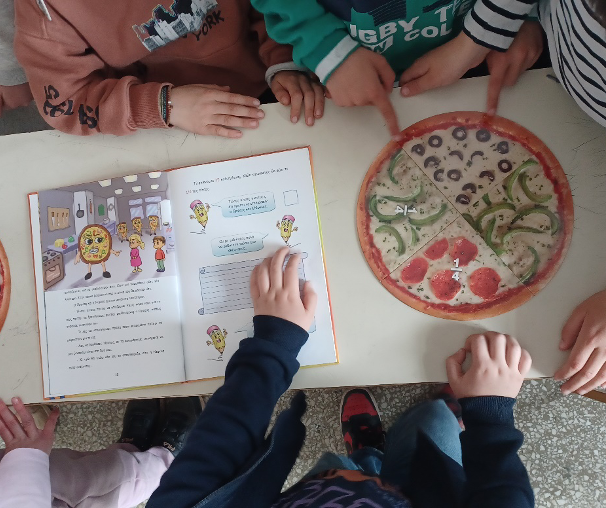
A child helping a story’s hero divide a pizza into equal pieces will understand the idea of one-half far more easily than if it were only written as a symbol on the board.
Storytelling as a Bridge to Inclusion
One of the most powerful aspects of storytelling is that it gives every student the chance to take part. It creates a learning environment where each child can be engaged, regardless of their level, background, or way of thinking. Stories build a shared foundation of understanding among pupils with different learning styles, linguistic backgrounds, and levels of confidence. Van den Heuvel-Panhuizen (2012) notes that when mathematics is placed within a story, the narrative becomes a “vehicle for thought” that connects language with logical reasoning. More recently, Trakulphadetkrai (2022) showed that storytelling supports language development and helps students make sense of mathematical ideas through familiar, everyday experiences.
Storytelling also provides a sense of safety. Within a story, mistakes are not failures but natural steps on the path toward understanding. Jo Boaler (2022) emphasises that the feeling of belonging is a foundation for mathematical confidence. When students feel that their ideas and ways of thinking are valued, they develop greater interest, persistence, and joy in learning — even when the challenges are demanding.
A Contemporary Pedagogical Perspective
Toor and Mgombelo (2015) describe storytelling as a way to “humanise mathematics.” They highlight that teaching is not merely the transmission of knowledge; it is a process that reaches the learner as a thinking and feeling human being, someone searching for their place within the classroom community.
Similarly, Peni and Phakeng (2021) show that storytelling helps build learning communities that are open and inclusive, especially in multicultural classrooms where students bring diverse experiences, languages, and forms of expression.
Through stories, children learn to discuss, to listen, to reason, and to understand one another.
In this way, the lesson stops being an individual exercise and becomes a shared journey of thought and meaning.
From Theory to Practice
In the Greek educational context, research by Ioanna Kaiafa and Charalampos Lemonidis (2020) showed that using stories to teach fractions significantly improved both understanding and engagement among all students, especially those who initially struggled the most. Storytelling acted as a linguistic and emotional framework that made mathematics more accessible and engaging for every learner.
Similar findings have been reported in more recent studies (Whitney, 2020; Trakulphadetkrai, 2022): when mathematics is embedded within stories or narrative problems, students develop greater creativity, reflection, and persistence in problem-solving.
Storytelling, Collaboration, and Meaning
Storytelling is not just another teaching method; it is a way of thinking. When children work together to solve a problem through a story, collaboration happens naturally — they share roles, combine ideas, and search for solutions as a team. The story gives them a shared purpose and a common framework that connects their efforts.
Even though storytelling offers a powerful approach to mathematics education, its implementation may present challenges. Limited curriculum time, structured syllabi, and varying levels of teacher preparedness can make narrative-based activities demanding in practice. Yet even small steps like a short episodic task, a character-based problem, or collaborative story creation, can make the method accessible.
The Enigmathico project is built on this very philosophy. Storytelling forms the core of the learning experience and, at the same time, seeks to support teachers in overcoming practical barriers to implementation. Students become protagonists who use mathematics to tackle real-world problems, from calculating the size of an oil spill to designing a sustainable city. Each mathematical concept gains a purpose, and every student finds a role within the collective process. This approach, collaborative, experiential, and inclusive, shows how storytelling can bring all learners together in a shared pursuit of understanding and meaning.
The Human Side of Mathematics
Storytelling restores to mathematics something that is often missing: the joy of discovery and the power of human connection. Through stories, students come to realise that mathematics is not a series of right answers, but a way to understand the world, to explain phenomena, and to think creatively.
As Boaler (2016) emphasizes, mathematics is a human and creative endeavor: a field that is not learned mechanically but experienced through thought, imagination, and collaboration. And as the pedagogy of storytelling shows, every student can take part, as long as we offer them a story that speaks to them and gives them a reason to think.
Conclusion
Storytelling makes mathematics more accessible because it transforms abstract ideas into human experiences. It builds bridges between emotion and logic, language and thought, diversity and participation. When students experience mathematical concepts through stories, they feel a sense of belonging, understand more deeply, and learn with joy. Because when mathematics speaks the language of storytelling, it speaks the language of every child.
References Ashcraft, M. (2002). Math anxiety: Personal, educational, and cognitive consequences.
Boaler, J. (2016). Mathematical Mindsets.
Boaler, J. (2022). Limitless Mind: Learn, Lead and Live without Barriers. Penguin.
Bruner, J. (1991). The Narrative Construction of Reality.
Egan, K. (1986). Teaching as Storytelling.
Kaiafa, I. & Lemonidis, C. (2020). Teaching Fractions through Storytelling.
Peni, R. & Phakeng, M. (2021). Storytelling as a pedagogy for inclusive mathematics classrooms.
Toor, A. & Mgombelo, J. (2015). Teaching Mathematics through Storytelling: Engaging the Being of a Student in Mathematics.
Trakulphadetkrai, N. (2022). Mathematics through Stories: Strengthening conceptual understanding and language development.
Van den Heuvel-Panhuizen, M. (2012). Realistic Mathematics Education and Contextual Learning.
Whitney, B. (2020). Narrative problem-solving in mathematics education.